Lost on a Canadian Trail? The Reflex That Could Save Your Life
Lost while hiking in Canada? Learn the STOP survival rule, why staying put saves lives, and what Search and Rescue teams wish every hiker knew before hitting the trail.
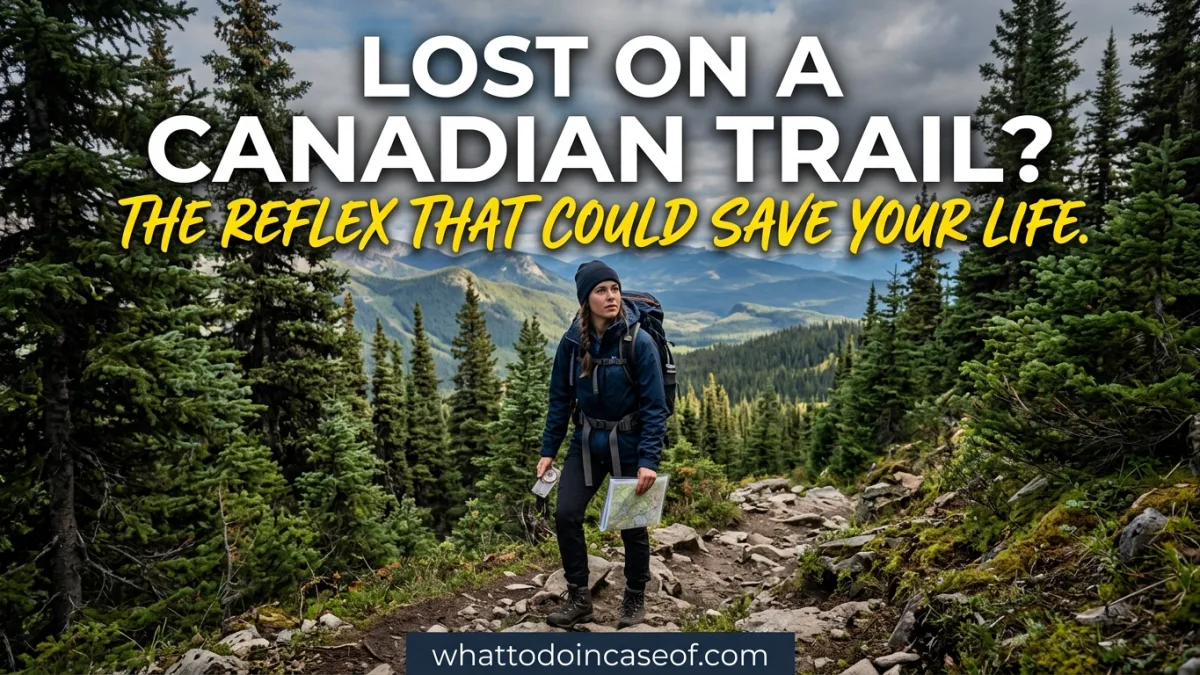
Opening Scene
The trail looked so obvious on the way up. You checked your watch at the summit, snapped a photo, turned around — and somewhere between the viewpoint and the parking lot, the path dissolved into a maze of identical pine trunks and moss-covered stone. Your phone shows one flickering bar of service, then none. The temperature is dropping faster than you expected, and the forest has gone quiet in that particular way that makes you realize you are very much alone.
If this scenario tightens your chest, you are not the target audience for a dramatic rescue story. You are the target audience for a rescue. And here is the part that surprises even experienced hikers: the people most likely to trigger a Search and Rescue call in Canada are not reckless tourists or Instagram influencers chasing impossible shots. They are locals who thought they knew the trail well enough to skip the prep.
In British Columbia alone — home to some of the highest Search and Rescue call volumes in the country — 95 percent of rescue calls involve local residents. Nearly one-third of those calls involve hikers between the ages of 20 and 29, often on trails they have walked dozens of times before. Getting lost while hiking in Canada is not a failure of courage or experience. It is a failure of context — and knowing how to respond when context collapses is what separates a good story from a tragic headline.
The Big Question
What exactly should you do in those first ten minutes after you realize you are lost? Not the theoretical answer you read in a pamphlet years ago. The real, boots-on-the-ground protocol that Canadian Search and Rescue teams wish every hiker had memorized before stepping onto a trail.
The answer is surprisingly simple, deceptively difficult, and almost never followed by the people who need it most.
The Backstory
Canada's wilderness is not forgiving in the way that more temperate landscapes can be. Dense boreal forest, sudden alpine weather shifts, and terrain that can turn from maintained trail to impassable bush in under a hundred metres create conditions where disorientation happens fast and hypothermia remains a threat even in July.
British Columbia operates 78 Search and Rescue teams staffed by roughly 3,200 volunteers — ordinary people with day jobs who drop everything when a call comes in. In 2024, those teams fielded nearly 2,000 calls combined. Across the entire country, ground search and rescue volunteers conduct more than 1,800 searches annually, dedicating over 150,000 hours to finding missing people in the backcountry.
The leading causes? Injuries, getting lost, and lacking the skill to navigate the terrain. In other words, the vast majority of these emergencies are preventable — and the response, when it matters, is governed by a four-letter acronym that rescue professionals have been teaching for decades.
What Happened?
The moment you suspect you are lost, your body will want to do the exact opposite of what it should. Adrenaline spikes. Your breathing quickens. The instinct to keep moving — to walk faster, to check just around the next ridge, to follow that stream downhill because surely it leads somewhere — becomes almost irresistible.
That impulse has a body count.
Search and Rescue teams do not begin their work from where you are now. They begin from your last known position — the trailhead, the summit register, the last text you sent. Every step you take while uncertain expands the search radius exponentially. A hiker who was 200 metres off-trail can wander themselves into a multi-day search simply by refusing to stop.
The protocol that interrupts this spiral is called S.T.O.P. — Stop, Think, Observe, Plan. Some instructors add a fifth letter, creating S.T.O.P.A., where the final A stands for Act — but only after the first four steps are complete.
Stop: As soon as disorientation sets in, freeze. Do not take another step. Continuing to walk while confused is the single biggest mistake lost hikers make, and it transforms a minor navigation error into a life-threatening emergency.
Think: Breathe deliberately. Ask yourself when you last felt certain of your location. What was the last landmark? How long ago? How much daylight remains? What gear do you actually have in your pack right now?
Observe: Study the terrain. Look for ridgelines, water features, or any sign of the trail you may have stepped off. Check your map, compass, or GPS. Turn around and look behind you — the route back often looks completely different in reverse. Listen for sounds of water, roads, or voices.
Plan: Unless you are completely certain of a short, safe path back to a known trail marker, your plan should be to stay put. Build a shelter. Signal for help. Conserve energy. And then act on that plan deliberately.
For a detailed, step-by-step breakdown of this protocol tailored specifically to Canadian conditions, see the guide at What to Do If Lost Hiking in Canada. It walks through the STOP rule with specific attention to the unique risks of Canadian wilderness — from sudden weather shifts to the particular danger of following drainages downhill into impassable terrain.
The Turning Point
Here is the insight that changes everything: staying put is not passive. It is a tactical decision that dramatically increases your odds of survival.
When you stop moving, you do three critical things simultaneously. You conserve energy and body heat. You prevent yourself from wandering into more dangerous terrain. And you give Search and Rescue a stationary target to find. In the Canadian backcountry, where weather can shift from sunny to sleet in under an hour, those first two factors are often what determine whether a rescue is a helicopter evacuation or a recovery mission.
The signaling protocol is equally deliberate. Three sharp blasts on a whistle — the international distress signal — repeated at regular intervals. Bright clothing or gear laid out in an open clearing, visible from the air. A mirror, watch face, or phone screen flashed at aircraft. At night, a headlamp or flashlight used in the same three-burst pattern.
If you have cell service, even a single bar, call 911 immediately. In Canada, local police or the RCMP coordinate Search and Rescue operations. If your signal is weak, try sending a text message — texts require far less bandwidth than voice calls and will often go through when calls fail.
For satellite phone users in Parks Canada jurisdictions, the emergency number is 403.762.4506. If you carry a personal locator beacon or satellite communicator like a Garmin inReach, activate the SOS feature without hesitation. Garmin now processes more than 3,000 SOS incidents annually, with hikers and backpackers consistently making up the largest group of rescuees.
The broader survival guide at What to Do If You Get Lost While Hiking covers additional critical details — including why you should never split up your group, how to insulate yourself from ground cold using nothing but evergreen boughs, and why dehydration accelerates hypothermia even when you do not feel thirsty.
What the Experts Are Saying
John Blown, a 23-year veteran of North Shore Rescue in British Columbia, has watched the psychology of lost hikers up close. His team responds to roughly 130 calls per year, a number that has climbed steadily over the past decade. He notes that social media plays an increasingly dangerous role — people see dramatic summit photos on Instagram and head out without researching the time, terrain, or equipment required.
Sandra Riches, executive director of BC Adventure Smart and a former park ranger, frames the issue with striking clarity: "The summit, the peak, the viewpoint is only halfway. Your destination is home." Her organization promotes the "Three Ts" — Trip planning, Training, and Taking the essentials — as the foundation of safe backcountry travel.
The data supports their urgency. In 2024, British Columbia's SAR teams handled 121 Category 1 calls — incidents where someone faced potentially fatal risk and needed urgent assistance. By mid-2025, the acuity of calls was already trending upward, with Squamish Search and Rescue on track for one of its busiest years ever.
The Bigger Picture
The Canadian Search and Rescue system is a remarkable patchwork of professionalism and volunteerism spread across 18 million square kilometres of land and water. Nearly 300 teams operate in every province and territory, and the service is generally free — though Parks Canada notes that individuals found negligent may be held responsible for costs.
But the system is not designed to compensate for poor preparation. There is no national data repository for SAR incidents, which means patterns are harder to track and prevention harder to target. What we do know is that the vast majority of backcountry emergencies share common DNA: a trip plan left with no one, inadequate navigation skills, and the fatal decision to keep walking while uncertain.
Technology is changing the landscape, but not always for the better. Satellite communicators have made calling for help easier than ever, but they can also create a false sense of security that encourages riskier behaviour. The most reliable survival tool remains the one between your ears — and the discipline to use it before panic sets in.
What Readers Should Remember
If you retain nothing else from this article, carry these five facts into every hike:
- Stop immediately. The moment you feel uncertain, freeze. Every step taken while lost makes you harder to find.
- Stay put. Search and Rescue teams start from your last known position. A stationary target is found faster.
- Signal deliberately. Three sharp whistle blasts. Bright gear in an open clearing. Flashing light at aircraft. Repeat.
- Call early. If you have any cell signal, call 911 or text. If you have a satellite device, trigger SOS without hesitation.
- Hypothermia is the silent killer. Even in summer, Canadian nights are cold. Insulate yourself from the ground, add layers before you start shivering, and build shelter while you still have daylight.
FAQ
How long should I wait before calling for help if I think I'm lost?
Call immediately if you have any means of communication. There is no benefit to waiting, and early notification gives Search and Rescue the maximum amount of daylight and weather window to work with. If you are uninjured and simply off-trail, rescuers can often talk you back to the path without deploying a full team.
Is Search and Rescue free in Canada?
Yes, in almost all cases. Provincial and federal SAR services are funded through government budgets and volunteer organizations. However, negligence can change that equation — Parks Canada, for example, may bill individuals who fail to register or de-register as required, or who are found negligent through court proceedings.
What is the most important item to carry to prevent getting lost?
A whistle is the single most underrated piece of safety gear — lightweight, battery-free, and effective over long distances. But the real answer is preparation: a detailed trip plan left with someone who will call for help if you do not check in, plus the skills to read a map and compass even when your phone dies. AdventureSmart Canada offers free trip-planning tools that can be filed online in under five minutes.
Should I follow a stream downhill if I'm lost?
In many survival manuals, following water downhill is standard advice. In Canada, it can be dangerous. Streams and drainages frequently lead to impassable swamps, dense alder thickets, or vertical drops rather than roads or civilization. Unless you are certain of the terrain ahead, staying put is almost always safer.
What temperature is dangerous for hypothermia in Canada?
Hypothermia can set in when your core body temperature drops below 35°C, and it does not require freezing air. Wet clothing combined with wind and temperatures as mild as 10°C can trigger it. The acronym COLD — Cover, Overexertion avoidance, Layers, Dry — is the framework BC emergency officials recommend for prevention.
Written by
Mohamed IDBRAHIM
I oversee the platform's development, content strategy, quality standards, and overall user experience. My goal is to make WhatToDoInCaseOf.com a reliable and practical resource where people can quickly find clear, useful information about what to do when facing everyday problems, unexpected situations, important decisions, and life challenges. I work to ensure that the platform remains easy to use, accessible, informative, and continuously improved with helpful guides, tools, calculators, and practical resources. Through a focus on clarity, usefulness, and innovation, I am committed to building a platform that helps people better understand their options and take the next step with confidence.
View profileSpotted an error? Report it — we correct mistakes promptly.
Keep reading
Related articles

What to Do If You Feel Tired After Drinking Coffee
You pour a coffee to wake up. Twenty minutes later you feel sharp, focused, ready. An hour after that, you could nap on the kitchen floor. If that sounds familiar, you are not imagining it and you are not broken. Coffee fatigue is a real, predictable pattern, and once you understand the mechanics,…

What to Do If You Miss Your Flight: A Complete Airport Survival Guide
Missed your flight? Don't panic. Learn exactly what to do if you miss your flight, from rebooking strategies to passenger rights, with this essential airport travel guide.

What to Do If Your House Suddenly Smells Bad 9 Places to Check First
You walk in the door, drop your keys, and stop. Something is off. The house smells wrong, and it wasn't like this when you left.
Related guides
Suspicious person at your door: what to do?
Suspicious person at your door: the right reflexes in a few simple steps.
Handing CCTV footage to the police: what to do?
Handing CCTV footage to the police: the right reflexes in a few simple steps.
What Should You Do If You Feel Like Nobody Understands You?
Feeling misunderstood is a common and painful human experience. This guide offers practical steps to cope, connect, and find support.