What to Do If Your Car Air Conditioning Stops Working - 9 Things to Check
You're stuck in traffic on a hot afternoon, and the air coming out of your vents is doing a bad impression of a hair dryer. You push the button harder, turn the dial to maximum, and nothing changes. It's one of those small failures that ruins a whole drive, and if you have kids or pets in the back,…
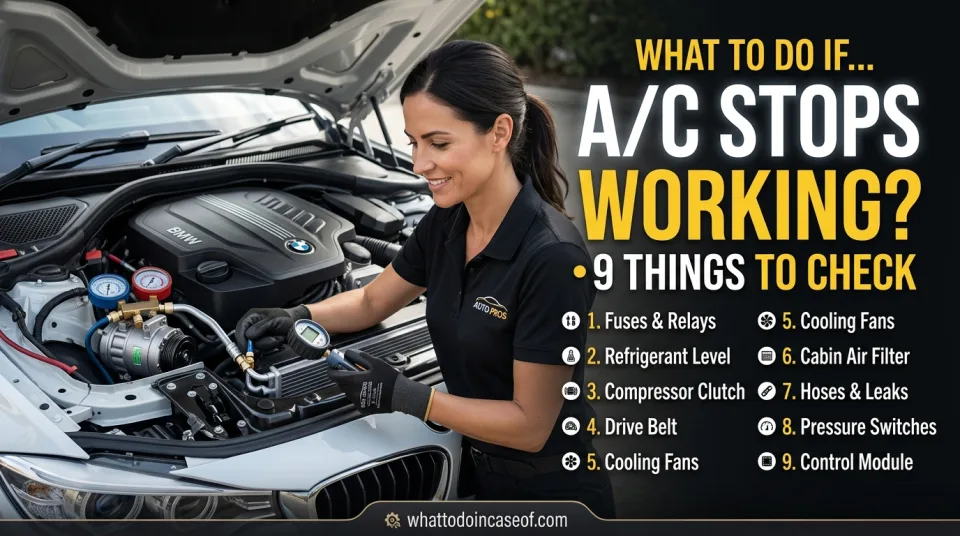
You're stuck in traffic on a hot afternoon, and the air coming out of your vents is doing a bad impression of a hair dryer. You push the button harder, turn the dial to maximum, and nothing changes. It's one of those small failures that ruins a whole drive, and if you have kids or pets in the back, it stops being a comfort problem and starts being a safety one.
Good news: you can diagnose most of what's wrong yourself, often in under ten minutes. This guide walks through nine things to check, in the order that saves you the most time and money.
The Problem: Why Your AC Quit on You
Car air conditioning is a sealed system, but "sealed" doesn't mean "permanent." Refrigerant slowly escapes through hoses, O-rings and seals over years. Compressors wear out. A $15 relay can fail and make the whole system look dead. Condensers get punched by road debris. Cabin filters clog with pollen until almost no air moves at all.
That variety is exactly why people waste money here. The most common mistake is assuming "no cold air" means "needs a recharge." Sometimes it does. Often the refrigerant leaked out because something failed, and topping it up just delays the real repair by a few weeks. The second most common mistake is dropping the car at a shop before checking the free stuff: fuses, relays, the cabin filter, whether the compressor is even engaging.
One more thing before you start. If the engine is overheating or you smell burning, stop and deal with that first. That's a different emergency. Our practical guides cover those situations if you need them.
Why It Happens: The Simple Version
Think of your AC as a loop that moves heat from inside the car to outside it. Refrigerant gets compressed, expands, absorbs heat from your cabin air, then dumps that heat through the condenser at the front of the car.
Every failure fits somewhere in that loop:
- No refrigerant (a leak somewhere) means nothing to absorb heat.
- No compressor (electrical fault, bad clutch, seized unit) means the loop never runs.
- No airflow (clogged cabin filter, dead blower fan) means cold air never reaches you.
- No heat exchange (dirty or damaged condenser) means the system can't dump heat, so it weakens or quits.
The symptom tells you a lot. Weak cooling that fades over months points to a slow leak. Total silence and no cold at all points to electrical or compressor issues. Cold air that barely comes out of the vents points to airflow. Two people in the same car can even disagree about whether it's working, because a system low on refrigerant often blows cold on the passenger side and warm on the driver's side.
The Solutions: 9 Things to Check
Work through these in order. The cheap checks come first on purpose.
1. Is the AC button actually on, and is the car in the right mode?
Start embarrassingly simple. Is the snowflake or "A/C" light lit? Is the temperature dial where you think it is? Many cars cut the compressor when you select defrost, and some economy modes cycle it on and off. If someone else drove your car last, check the settings before you check anything else.
2. The cabin air filter
This is a ten-minute job on most cars and a genuine fix more often than people expect. A filter packed with leaves and dust strangles airflow, so even a healthy AC feels weak. Filters typically cost roughly $10-$30 depending on the car, and you can often find a video for your exact model. If yours is gray and matted, you just found part of the problem.
3. Fuses and relays
A blown fuse or a tired relay kills the compressor clutch with no warning. Your owner's manual shows which fuse and relay run the AC, usually in the box under the hood. Pull the fuse and hold it up to the light: if the metal strip inside is broken, replace it with one of the same rating. A relay is cheap to swap and easy to rule out.
4. Does the compressor clutch engage?
With the engine running and AC on full, watch the compressor (the belt-driven unit with the pulley at the front). The center of the pulley should spin when the clutch engages, and you'll often hear a click as it kicks in. If the outer pulley spins but the center never moves, the clutch isn't engaging, which points to electrical trouble or low refrigerant pressure triggering a safety cutoff. Don't poke your fingers near a spinning belt.
5. The condenser at the front of the car
The condenser looks like a small radiator sitting ahead of your engine radiator. Bugs, leaves and bent fins block airflow. A gentle rinse with a garden hose from the front, engine off and cool, can help. If you see obvious impact damage or oily wet patches, you likely have a leak, and that's a shop job.
6. The blower fan
If almost no air comes out of the vents at any speed setting, the problem isn't the AC at all. It's the blower motor, its resistor, or its fuse. Testing this is easy: crank the fan to maximum with the AC off. Weak or silent airflow means you're chasing the wrong system.
7. Refrigerant level and obvious leaks
You can't judge refrigerant by looking at the system the way you check oil. But you can look for oily residue on hoses and fittings, which is where refrigerant oil escapes with the gas. If you find it, you have a leak, and recharging without fixing it is money down the drain.
8. Belt and pulley noise
A squealing belt when you switch the AC on suggests the belt is slipping or worn. On many modern cars one serpentine belt runs everything, so a failing belt is worth fixing before it strands you. This is a safety-adjacent repair, not a comfort one.
9. Get a proper pressure test
If everything above checks out, a shop can measure system pressures in minutes and tell you whether you're low on refrigerant, overcharged, or dealing with a failing compressor. Ask for the pressure readings, not just a verdict. A professional recharge typically runs in the range of roughly $150-$300 depending on the refrigerant type and your region, and prices vary a lot, so call around.
The Best Choice Depends on What You Found
If the problem is airflow (filter, blower), you can almost certainly fix it yourself for very little money, and you should. If it's a fuse or relay, same story.
If you found a leak, or the compressor isn't engaging after the electrical checks, you're into diagnostic-and-repair territory that needs gauges, a vacuum pump and refrigerant handling equipment. That's not a driveway job for most people, and in many places it's regulated. This is where a good local shop pays for itself. If you don't have a mechanic you trust, a trusted local provider directory can help you find one rather than picking a name at random.
And if you have young children or pets who ride with you, don't treat a dead AC as cosmetic in summer. A car interior can reach dangerous temperatures fast, even on mild days. The kids and family safety section covers heat safety in and around vehicles, and it's worth five minutes of your time.
Step-by-Step Action Plan
- Park somewhere safe and cool the car down if you can. Open windows, find shade.
- Check the controls. AC on, recirculation on, temperature to cold, fan to max.
- Listen and feel. Does air come out at all? Does it start cold and fade? Note the pattern.
- Pop the hood with the engine off and inspect the condenser for debris or damage.
- Check the cabin filter if you can reach it. Replace if dirty.
- Check the AC fuse and relay against your owner's manual.
- Start the engine and watch the compressor clutch for a few minutes with the AC on. Does it click and spin?
- Look for oily residue on AC hoses and fittings.
- If nothing obvious turns up, book a pressure test and ask for the actual readings.
Write down what you observed. "Blows cool for ten minutes then warm" is a far more useful thing to tell a mechanic than "it's broken," and it can save you diagnostic time you'd otherwise pay for.
Common Mistakes to Avoid
- Assuming it just needs refrigerant. Fix: look for a leak first, or you'll be back in a month.
- Buying a DIY recharge can before diagnosing. Fix: check fuses, filter and clutch engagement first. Those are free.
- Ignoring the cabin filter. Fix: replace it yearly in dusty or pollen-heavy areas.
- Running the AC on recirculation forever in a hot car. Fix: use fresh air briefly to purge the hottest air, then switch back.
- Letting a shop recharge without finding the leak. Fix: ask what they found and where.
- Using stop-leak refrigerant products. Fix: skip them. They can clog the system and turn a small repair into a big one.
- Leaving kids or pets in a hot car "for two minutes." Fix: don't. Ever.
Expert Takeaway
The single most important lesson: diagnose before you spend. A dead AC has maybe a dozen possible causes, and the cheapest ones (filter, fuse, relay, controls) are the ones you can check yourself in under half an hour. Rule those out first, then pay for a proper pressure test with real numbers. You'll either fix it for pocket change or walk into the shop knowing exactly what you're buying.
FAQ
Why is my car AC blowing warm air but the fan works?
Air moves but isn't cold, which usually means the refrigerant loop isn't doing its job. Common causes are low refrigerant from a leak, a compressor that isn't engaging, or a blocked condenser. Check the compressor clutch and fuses first, then get a pressure test.
Can I just recharge my car AC myself?
You can buy DIY cans, but they only help if the system is mildly low and otherwise healthy. If there's a leak, you're wasting money, and overcharging can damage the compressor. If you don't know the system pressures, a shop recharge is the safer bet.
How much does it cost to fix car air conditioning?
It depends entirely on the cause. A cabin filter or fuse might cost you under $30. A recharge typically falls in the $150-$300 range. Compressor replacement can run into four figures on some vehicles. Get a written estimate before agreeing to work.
Why does my AC blow cold on one side and warm on the other?
This often points to low refrigerant, which affects one side of the system first. It can also be a blend door or actuator problem in the dashboard. Either way, it's worth diagnosing rather than ignoring, because it usually means something is failing.
Is it safe to drive with the AC broken?
Mechanically, usually yes, though a failing compressor or belt can cause bigger problems if ignored. The real risk is heat. In warm weather, a car without working AC can become dangerously hot for children, older adults and pets. If that's your situation, treat it as urgent, not optional.
This article is general information, not professional automotive or medical advice. If you're unsure about a repair, or if heat exposure is a concern for anyone in your car, seek qualified help.
Written by
Mohamed IDBRAHIM
I oversee the platform's development, content strategy, quality standards, and overall user experience. My goal is to make WhatToDoInCaseOf.com a reliable and practical resource where people can quickly find clear, useful information about what to do when facing everyday problems, unexpected situations, important decisions, and life challenges. I work to ensure that the platform remains easy to use, accessible, informative, and continuously improved with helpful guides, tools, calculators, and practical resources. Through a focus on clarity, usefulness, and innovation, I am committed to building a platform that helps people better understand their options and take the next step with confidence.
View profileSpotted an error? Report it — we correct mistakes promptly.
Keep reading
Related articles

What to Do If Your Check Engine Light Comes On
You're driving along, everything's fine, and then that little amber engine icon lights up on your dashboard. Your stomach drops a bit. Is the car about to die? Are you about to be handed a four-figure repair bill?

What to Do If Your Car Battery Dies - 8 Steps to Get Back on the Road
You turn the key. Instead of the engine catching, you get a slow, sickly groan, then a click, then nothing. The dashboard lights dim. Somewhere in the back of your mind you already know: the battery is dead, and you're stuck.

What to Do If Your Child Spends Too Much Time on Screens
Your nine-year-old has been on the tablet since breakfast. You've asked three times for it back. You're tired, you feel like the bad guy
Related guides
Car overheating: what to do?
Car overheating: the right reflexes in a few simple steps.
What to Do If You Have a Car Accident
Knowing the exact steps to take immediately following a vehicle collision helps protect lives, prevents secondary hazards, and ensures proper documentation.
Heating failure in winter: what to do?
Heating failure in winter: the right reflexes in a few simple steps so you can react without panicking.